Sail
Cloth spread from a mast so that the wind, not human muscle, drives a boat and its cargo.
Das tiefe Archiv ist vorerst auf Englisch verfasst — geprüfte Übersetzungen stehen auf der Roadmap. Die Übersetzungsfunktion Ihres Browsers funktioniert auf dieser Seite gut.
✦ Moment, wirklich?
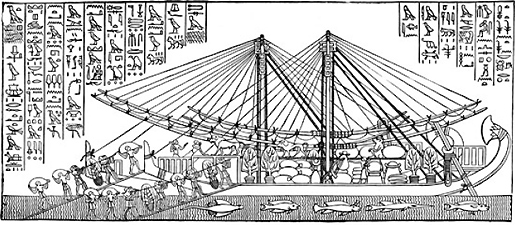
On the Nile the prevailing wind blows south while the current flows north, so Egyptian boats sailed upstream and drifted home. The arrangement was so fundamental that the hieroglyph for "travel south" is a boat with its sail raised, and "travel north" a boat with the sail down.
Was es ist
A sail is a sheet of woven fabric hung from a mast and controlled by ropes, turning a hull into a machine that harvests the wind. The wind pushes on the cloth; the cloth pulls the ship; rigging and steering let the crew choose the direction. The earliest form was a single square sail, useful only when the wind blew roughly where you wanted to go — later rigs turned even a contrary wind into forward motion.
Warum es zählte
Wind is free freight. A modest sailing ship worked by a crew of twenty could carry more cargo than a thousand porters, farther and faster, which made bulk trade in grain, timber, wine, stone, and metal economically possible for the first time. Rivers and coastlines became the highways of the ancient world; the earliest depictions of sails, on Egyptian pottery from before 3000 BC, belong to the same Nile world that fed the first territorial state.
Wie es gemacht wurde
The first sails were squares of woven linen or plaited reed matting, lashed to a wooden yard hoisted up a mast and held by ropes of plant-fiber cordage — the sail is as much a textile achievement as a nautical one. Downwind sailing needed little more; the great refinement was the fore-and-aft rig, exemplified by the triangular lateen sail spreading through the Indian Ocean and Mediterranean in late antiquity, which let ships sail at a steep angle into the wind and tack their way to windward. With that, the wind ceased to dictate the route.
Was es erschloss
Sail built the maritime world: Mediterranean grain fleets, Indian Ocean monsoon trade, the Austronesian settlement of the remote Pacific, Viking passages to Iceland and beyond. Every port city, naval power, and sea-borne empire ran on it, and celestial navigation, cartography, and the age of exploration all grew up in its service. Until the steamship — nearly five thousand years later — anything heavy that traveled far traveled by sail.
Kleinste funktionsfähige Version
A single square of woven cloth or matting lashed to a yard on a short mast, stayed with ropes, hoisted when the wind blows the way you are going and dropped when it does not.
Setzt voraus
Erschloss
Quellen
- — Lionel Casson, *Ships and Seamanship in the Ancient World* (1971)
- — Seán McGrail, *Boats of the World: From the Stone Age to Medieval Times* (2001)
Stimmt etwas auf dieser Seite nicht? Jede Behauptung hier soll dem Widerspruch standhalten. Eine Korrektur vorschlagen →