Rechargeable battery (lead-acid)
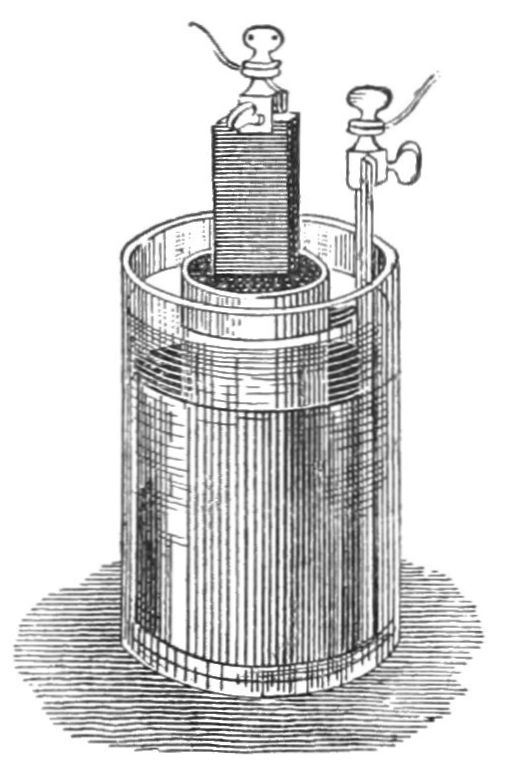
Two lead plates in dilute sulfuric acid that can be discharged and then driven back to full charge by a reverse current — the first battery that did not have to be thrown away when it went flat. Heavy and low in energy, but able to deliver a huge burst of current cheaply.
L'archive profonde est pour l'instant rédigée en anglais — des traductions vérifiées font partie de la feuille de route. La fonction de traduction de votre navigateur fonctionne bien sur cette page.
✦ Attendez, vraiment ?
The battery under the hood of nearly every car is still Planté's 1859 chemistry — the oldest rechargeable design ever put into mass production and still made by the hundreds of millions each year. One firm alone, Clarios, builds over 150 million lead-acid batteries a year, enough to start about one in every three vehicles on Earth.
Ce que c'est
A lead-acid cell is two lead plates in acid whose chemistry runs both ways. On discharge, both plates react with the sulfuric acid and turn toward lead sulfate, releasing current; on charge, an outside current forces that reaction into reverse, rebuilding one plate as lead dioxide and the other as spongy lead. Nothing is consumed for good — the same metal and acid cycle back and forth. That reversibility is the entire invention. Every earlier battery, from Volta's pile onward, ate its own materials and was dead when they were spent.
Pourquoi cela a compté
A battery you can refill changes electricity from a consumable into a reservoir. You can charge it when power is cheap or plentiful and draw it down when you need it — for a telegraph office, an early car's starter, a submarine, a backup light when the grid fails. Lead-acid is heavy and stores little energy for its weight (about 30–40 watt-hours per kilogram, poor even by later standards), but it is cheap, rugged, and can dump an enormous current for a few seconds. That last trait is exactly what a car needs to crank a cold engine, which is why a 19th-century chemistry is still the standard automobile battery.
Comment cela a été fait
Planté rolled two strips of pure lead into a spiral, separated by cloth, and stood them in dilute sulfuric acid. The catch was that fresh lead plates hold almost no charge; they must be "formed" by cycling — charged, discharged, charged again, over and over — until each builds up a thick layer of active material. Planté's cells needed long, patient forming before they were useful, and later makers sped this up by pasting the plates with lead oxide paste rather than growing the layer from solid metal. The principle never changed.
Ce que cela a débloqué
Rechargeable storage made electricity dispatchable for the first time: early power stations used banks of lead-acid cells to carry the load at night and smooth demand, telegraph and telephone exchanges ran on them, and the electric starter motor — which ended hand-cranking and made cars something anyone could drive — depends on the lead-acid battery's cheap burst of current to this day. It also set the template every later rechargeable battery followed, right up to lithium-ion: store energy as a reversible chemical change, and pour current back in to undo it.
Version minimale viable
Two pure lead plates, kept apart by a spacer, standing in dilute sulfuric acid; charged from an outside current source until one plate turns to brown lead dioxide, then used and recharged over and over.
Recette d'amorçage
Il vous faut
- · Two sheets or strips of pure lead, as large in area as convenient (Planté rolled his into a spiral to pack more area into a jar)
- · A porous separator — cloth, rubber strip, or a gap — to keep the plates from touching
- · Dilute sulfuric acid, roughly one part acid to four or five parts water (a specific gravity near 1.25); always add acid to water, never the reverse
- · A glass or acid-proof jar
- · A source of direct current to charge it — another battery, a voltaic pile, or a small dynamo
Étapes
- 01Stand the two lead plates in the acid, kept apart by the separator; connect each to a terminal.
- 02Charge: pass direct current through. One plate slowly grows a coat of chocolate-brown lead dioxide (PbO2); the other becomes clean grey spongy lead.
- 03Form the plates: discharge the cell, then charge it again, and repeat many times over hours or days. Each cycle deepens the active coating until the cell holds a useful charge — this slow 'forming' is the whole trick, and Planté's cells needed long forming before they were any good.
- 04Use it: a single formed cell gives about 2 volts. Stack cells in series for more (a car battery is six cells, about 12 volts).
- 05Recharge whenever it runs down, before it sits flat for long.
Comment savoir que cela a fonctionné
A formed cell reads about 2.0–2.1 volts across its terminals with no load, and can light a small bulb or spin a motor, then be brought back to that voltage by charging. The charged positive plate is unmistakably dark brown (lead dioxide); the negative is grey. If it holds 2 volts, drives a load, and recovers after charging, it works.
Ce qui tourne mal
- ⚠ Left flat too long — hard pale lead-sulfate crystals build up on the plates ('sulfation') and will not convert back; the cell loses capacity permanently.
- ⚠ Plates touch through a gap in the separator — a dead short that heats up and kills the cell.
- ⚠ Overcharging — the water splits into hydrogen and oxygen and bubbles away; the gas is explosive, so charge in ventilation and top up with distilled water.
- ⚠ Acid too strong or too weak — too concentrated attacks the plates, too dilute gives little current.
A débloqué
Sources
- — Gaston Planté, *Recherches sur l'électricité* (1879), collecting his 1859–1860 papers to the Académie des Sciences
- — D. Pavlov, *Lead-Acid Batteries: Science and Technology* (2011)
- — Kurzweil, 'Gaston Planté and his invention of the lead–acid battery — the genesis of the first practical rechargeable battery,' *Journal of Power Sources* (2010)
Quelque chose d'inexact sur cette page ? Chaque affirmation ici est censée survivre à la contestation. Suggérer une correction →