Insurance
A way to make a rare catastrophe survivable by pooling it. Many people facing the same risk each pay a small, certain premium; the few who actually suffer the loss are paid out of the common pool. It converts a ruinous maybe into a bearable, predictable cost.
深层档案目前以英文写就——经核验的翻译已列入路线图。浏览器自带的翻译功能在本页表现良好。
✦ 等等,真的吗?
The word "underwriter" is literal. At Edward Lloyd's coffee house on Tower Street — first named in the London Gazette in February 1688 — a merchant who agreed to shoulder part of a ship's risk wrote his name underneath the written description of the vessel and voyage, pledging to pay his share of any loss in exchange for a share of the premium. Marine insurance was transacted one signature at a time, under the line.
它是什么
Insurance is a machine for spreading a loss too big for one person to bear across many people who might have borne it. Each participant pays a small, certain amount — the premium — into a common pool. When catastrophe strikes one of them, the pool pays. The insured has traded an unlikely disaster for a definite, survivable cost, and the insurer has taken on the disaster because, across enough insured parties, the total losses are predictable even though any single loss is not. The whole thing rests on a mathematical fact: individually, whether *your* ship sinks is nearly unknowable; collectively, the *fraction* of ships that sink each year is stable enough to price.
它为何重要
Without insurance, any venture large enough to matter is also large enough to ruin you if it fails, so the rational move is not to venture. A merchant who would be wiped out by one lost cargo will not send the ship; a family wiped out by one bad harvest cannot take the risk that lets them get ahead. Insurance decouples the courage to act from the capacity to absorb the worst case. It is what let long-distance trade, and later factories, railways, and mortgages, be financed at all — because the catastrophic tail of the risk could be handed to someone equipped to pool it. It converts the sentence "this could destroy me" into the line item "this costs me X per year."
它解锁了什么
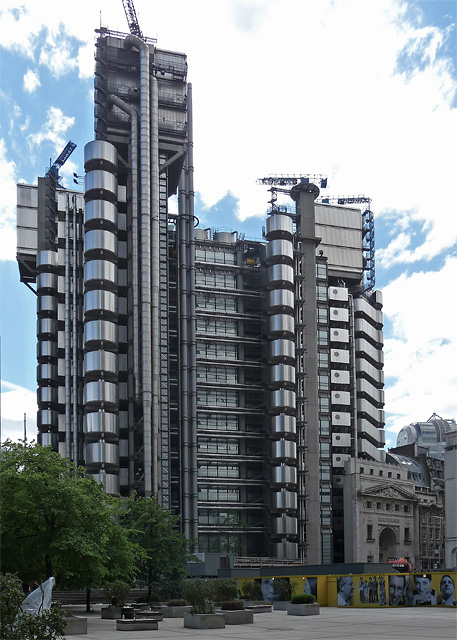
Priced risk is the hidden substrate of modern economic life. Ships that would never have sailed uninsured; factories built because fire could be laid off onto an insurer; the entire edifice of pensions, mortgages, and reinsurance — all of it stands on the pool. Lloyd's itself grew from the coffee-house tables into a global market that would famously insure almost anything with a computable risk. And the underlying idea generalized far past commerce: the notion that a whole society can pool the misfortunes of its members — against illness, unemployment, old age — is insurance scaled to the size of a nation.
最简可行版本
A group exposed to the same hazard agrees in writing that each will pay a set premium into a common fund, from which any member who suffers the named loss is compensated — with the premium set high enough, given the odds, that the fund stays solvent. Bottomry loans on ships (antiquity) and medieval guild burial funds are early forms; Lloyd's turned it into a standing market.
此条目尚待完整撰述——制图师正在工作。它在图中的位置已经核验无误。
解锁
前沿——此后尚未绘制。
来源
- — Edmond Halley, 'An Estimate of the Degrees of the Mortality of Mankind,' *Philosophical Transactions* 17 (1693), 596–610
- — Peter L. Bernstein, *Against the Gods: The Remarkable Story of Risk* (1996)
- — Geoffrey Clark, *Betting on Lives: The Culture of Life Insurance in England, 1695–1775* (1999)
发现本页有误?这里的每一条论断,都应当经得起质疑。 提交更正 →