AC power system
A way to move electric power across long distances cheaply: generate alternating current, use transformers to step it up to high voltage for transmission (which slashes line losses) and back down for safe use, and drive polyphase motors that need no commutator.
El archivo profundo está escrito en inglés por ahora; las traducciones verificadas forman parte de la hoja de ruta. La función de traducción de tu navegador funciona bien en esta página.
✦ Espera, ¿en serio?
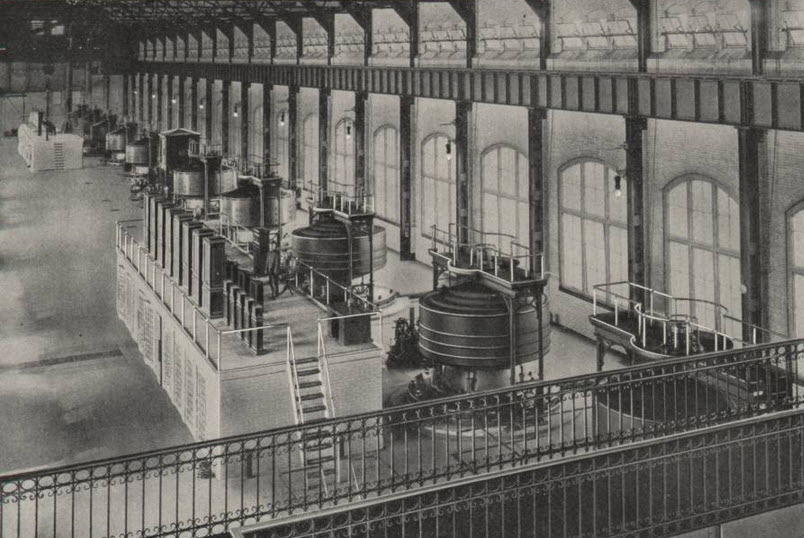
The choice between alternating and direct current was fought out as the 'War of the Currents'. Thomas Edison, whose empire ran on DC, campaigned against Westinghouse and Tesla's AC by staging public electrocutions of animals and quietly promoting the AC-powered electric chair — first used in 1890 — to brand rival current as the 'killer'. AC won anyway: in 1895 the great generators at Niagara Falls were built to send AC power, and by 1896 it reached Buffalo, twenty-six miles away.
Qué es
An AC power system is the machinery for making electricity a thing you pipe across a region rather than generate at your doorstep. Its trick is the transformer, and the transformer only works on *alternating* current — current that reverses direction many times a second, so its changing magnetic field can induce a voltage in a second coil. That lets you cheaply trade voltage for current and back: step the voltage way up to send power down a wire, then step it back down where people use it. Around that sit alternators to generate the AC, transmission lines to carry it, and polyphase motors — fed by two or three currents staggered in time — that spin from the resulting rotating magnetic field with no sparking commutator to wear out.
Por qué importó
Power lost heating a transmission line rises with the *square* of the current it carries. So to send power far, you want very low current — which means very high voltage, since power is voltage times current. But no one can use tens of thousands of volts safely in a home or a motor. Edison's direct-current system had no cheap way to change voltage, so it was stuck: generate and use at roughly the same low voltage, which meant a power station every mile or so and fat copper mains. The transformer broke that deadlock. High voltage for the long haul, low voltage at the socket — and suddenly one big, efficient power station could serve a whole city and beyond. That is why the grid is AC, and why power plants can sit at the coal seam or the waterfall instead of downtown.
Qué desbloqueó
AC transmission is the physical shape of the modern world's nervous system: the continental power grid, in which distant hydro dams, coal plants, and later nuclear and wind farms all feed a shared high-voltage network that any city can draw from. The 1895 Niagara Falls project was the proof — turning a waterfall into electricity and sending it to Buffalo — and it settled the War of the Currents for good. Once power could travel, industry no longer had to cluster at the energy source; factories, streetcars, and eventually every electrified thing spread wherever the wires reached. The 50/60-hertz alternating current in the wall today, and the transformer on the pole outside, are the direct descendants of Stanley's 1886 circuit and Tesla's rotating field.
Versión mínima viable
A single-phase system: an alternator feeding a step-up transformer, a transmission line at high voltage, and a step-down transformer at the far end supplying lamps — the arrangement William Stanley wired for Westinghouse in Great Barrington, Massachusetts, in 1886. Polyphase (Tesla's two- and three-phase) added smooth motor power and came right behind it.
Esta entrada espera aún su relato completo: los cartógrafos están trabajando. Su lugar en el grafo ya está verificado.
Requiere
Hilos que pasan por esta capacidad
How did lightning become the power grid?7 pasosFuentes
- — Jill Jonnes, *Empires of Light: Edison, Tesla, Westinghouse, and the Race to Electrify the World* (2003)
- — Nikola Tesla, US Patents 381,968 and others on the polyphase system and induction motor (1888)
- — Thomas P. Hughes, *Networks of Power: Electrification in Western Society, 1880–1930* (1983)
¿Algo está mal en esta página? Cada afirmación aquí está hecha para sobrevivir al escrutinio. Sugiere una corrección →