Electromagnetic field theory
Maxwell's field equations, which fold electricity, magnetism, and light into one system: a changing electric field makes a magnetic field and a changing magnetic field makes an electric field, and together they travel through space as waves. The equations predicted those waves move at the speed of light — so light itself is electromagnetic.
El archivo profundo está escrito en inglés por ahora; las traducciones verificadas forman parte de la hoja de ruta. La función de traducción de tu navegador funciona bien en esta página.
✦ Espera, ¿en serio?
Maxwell worked out the speed of his predicted waves without measuring any light. He took it from bench measurements of electricity and magnetism alone — the ratio of the electrostatic to the electromagnetic unit of charge, about 3.1×10^8 metres per second — and it landed squarely on the already-measured speed of light (Fizeau's roughly 3.15×10^8 m/s). "The agreement of the results," he wrote, "seems to show that light and magnetism are affections of the same substance."
Qué es
Maxwell's theory says the fundamental actors are not charged objects pulling on each other across empty space but *fields* — conditions of the space itself that carry electric and magnetic influence and store energy. Four equations describe how charges and currents produce these fields and how the fields feed one another: a changing magnetic field induces an electric field, and (Maxwell's own crucial addition, the "displacement current") a changing electric field induces a magnetic one. Because each field regenerates the other as it changes, a disturbance can hand itself forward through empty space indefinitely — an electromagnetic wave. The theory then delivers the wave's speed as a combination of two measured electrical constants, and that speed is the speed of light.
Por qué importó
This was the first grand unification since Newton, and it folded three previously separate subjects — electricity, magnetism, and optics — into one. It also predicted something no one had seen: invisible electromagnetic waves at frequencies far below and above visible light. More deeply, it shifted physics away from Newton's picture of instantaneous forces-at-a-distance toward fields that carry influence at finite speed, the framework in which all of modern fundamental physics is written. And the numerical coincidence at its heart — that a ratio you could measure with charges and magnets equals the speed of light — was the moment optics became a branch of electromagnetism.
Qué desbloqueó
Hertz's laboratory waves became radio, and then radar, television, microwaves, and every form of wireless communication — all of it one phenomenon at different frequencies. The theory's insistence that light always travels at that fixed speed, the same for every observer, was the puzzle that drove Einstein to special relativity in 1905. Electromagnetic field theory also underwrites the rigorous design of alternating-current power systems, and it is part of the physical understanding of the atom that the discovery of nuclear fission would later rest on.
Versión mínima viable
Four coupled equations (as Oliver Heaviside later distilled Maxwell's original twenty): electric charges make electric fields; there are no isolated magnetic charges; a changing magnetic field makes an electric field (Faraday's law); and a changing electric field or a current makes a magnetic field (the Ampère–Maxwell law). Together they yield a self-propagating wave moving at 1/√(ε₀μ₀), which is the speed of light.
Esta entrada espera aún su relato completo: los cartógrafos están trabajando. Su lugar en el grafo ya está verificado.
Fuentes
- — James Clerk Maxwell, "A Dynamical Theory of the Electromagnetic Field," *Philosophical Transactions of the Royal Society* 155 (1865)
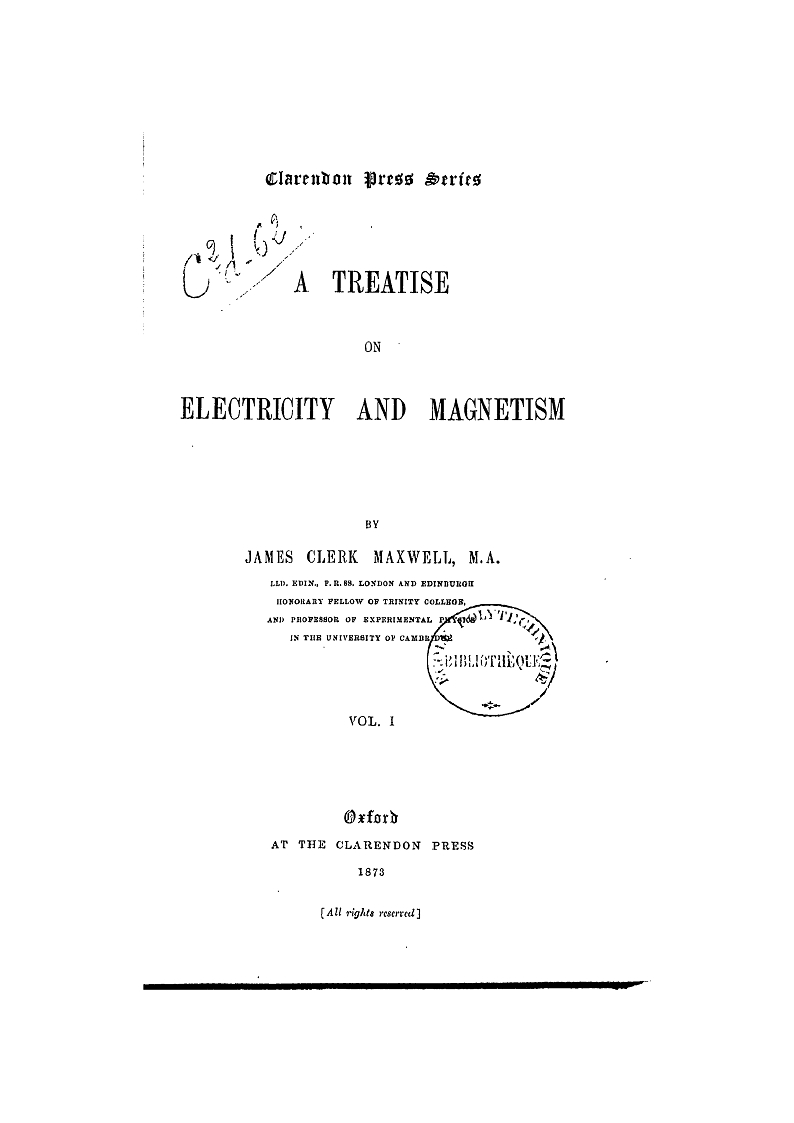
- — James Clerk Maxwell, *A Treatise on Electricity and Magnetism* (1873)
¿Algo está mal en esta página? Cada afirmación aquí está hecha para sobrevivir al escrutinio. Sugiere una corrección →