Large Language Models
Neural networks trained on internet-scale text to predict the next word — and which, at sufficient scale, turn out to translate, code, reason, and converse without being taught any of those skills directly.
El archivo profundo está escrito en inglés por ahora; las traducciones verificadas forman parte de la hoja de ruta. La función de traducción de tu navegador funciona bien en esta página.
✦ Espera, ¿en serio?
An LLM's entire education is a single game: guess the next word. Nobody programmed translation, arithmetic, or coding into them — those abilities emerged, uninvited, once the models and their training data got big enough — though just how sharply they emerge is contested.
Qué es
A transformer neural network with hundreds of billions of parameters — GPT-3 had 175 billion, with frontier models estimated to reach the trillions — trained to predict the next token across trillions of words of text, then refined with human feedback into a conversational assistant.
Por qué importó
Language is the interface to almost all recorded human knowledge. A machine that genuinely handles language becomes a general-purpose collaborator — the first technology in this graph that can read the graph itself.
Cómo se hizo
Web-scale text is tokenized and fed through a transformer trained by gradient descent on next-token prediction, typically across thousands of GPUs for months; a second, far smaller phase aligns the raw predictor into a helpful assistant via human preference feedback.
Qué desbloqueó
Open — this is currently a frontier node of the graph. Candidate downstream nodes: AI-assisted software engineering, machine-readable knowledge corpora (this project), autonomous agents and robotics.
Versión mínima viable
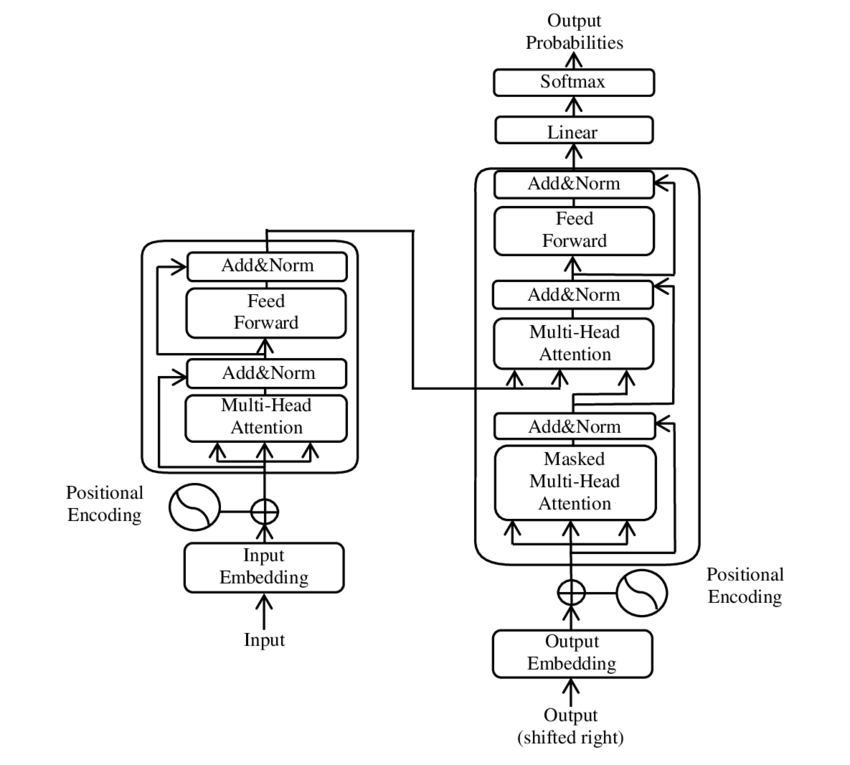
A transformer-architecture network (2017) trained autoregressively on a large web-text corpus — the GPT recipe.
Desbloqueó
Frontera: nada cartografiado todavía.
Hilos que pasan por esta capacidad
How did lightning become ChatGPT?12 pasosFuentes
- — Vaswani et al., 'Attention Is All You Need' (2017)
- — Brown et al., 'Language Models are Few-Shot Learners' (2020)
¿Algo está mal en esta página? Cada afirmación aquí está hecha para sobrevivir al escrutinio. Sugiere una corrección →