Lenses
Glass ground into curved surfaces that bend light to a focus — correcting aging eyes, and, stacked in tubes, revealing worlds too far or too small to see at all.
L'archive profonde est pour l'instant rédigée en anglais — des traductions vérifiées font partie de la feuille de route. La fonction de traduction de votre navigateur fonctionne bien sur cette page.
✦ Attendez, vraiment ?
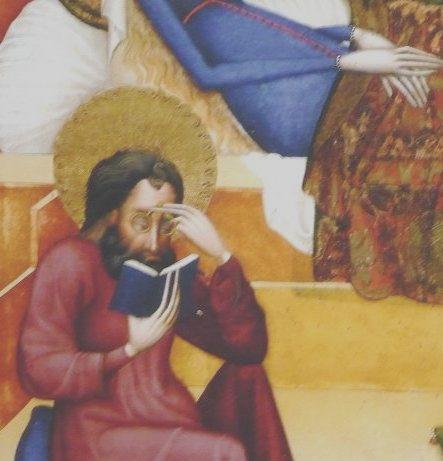
We can date eyeglasses to about 1286 because of a sermon: in 1306 the friar Giordano da Pisa told a Florence congregation that "it is not yet twenty years since there was found the art of making spectacles," adding that he had personally met the man who first made them.
Ce que c'est
A lens is a piece of clear glass with deliberately curved faces. Because light bends when it crosses between air and glass, the curvature gathers rays to a focus: a convex lens magnifies and corrects farsight, a concave one corrects nearsight. Two lenses held in line make a telescope or a microscope — the same trick, pointed in opposite directions.
Pourquoi cela a compté
Around age forty-five, nearly every human eye loses the ability to focus close up. Before spectacles, that ended the working life of scribes, scholars, notaries, and fine craftsmen at exactly the age of their greatest skill; after spectacles, careers of the eye ran decades longer. The payoff compounded with printing — cheap books created millions of aging readers — and Europe's spectacle workshops became the training ground and market that made precision optics an industry.
Comment cela a été fait
A disc of clear glass was ground against a curved metal form — convex blank in concave dish — with wet sand or emery, working down to ever finer abrasive, then polished to transparency with pitch and fine powder. The skill was keeping the curve true and the surface flawless, all judged by hand and eye. Spectacle makers in Pisa and Venice turned this into a trade within a generation of the invention.
Ce que cela a débloqué
In 1608 a Dutch spectacle maker put two lenses in a tube, and within two years Galileo had seen the moons of Jupiter — evidence, visible to anyone who looked, that not everything orbits the Earth. The microscope did the same for the small: cells, capillaries, and the "animalcules" that eventually became germ theory. Lenses made the very large and the very small into public facts, and became the eyes of every later instrument — camera, spectroscope, and sextant telescope alike.
Version minimale viable
A convex reading lens ground by hand: a glass blank rubbed against a curved metal or stone form with wet sand, then finer abrasive, then polished to clarity on pitch.
Requiert
Fils passant par cette capacité
How did a forgotten flask become the vaccine?6 étapesHow did we learn to stop dying from infections?6 étapesHow does sand become a CPU?7 étapesSources
- — Vincent Ilardi, *Renaissance Vision from Spectacles to Telescopes* (2007)
- — David C. Lindberg, *Theories of Vision from al-Kindi to Kepler* (1976)
Quelque chose d'inexact sur cette page ? Chaque affirmation ici est censée survivre à la contestation. Suggérer une correction →