Zero and place value
A way of writing numbers in which a digit's meaning depends on its column, and a symbol for nothing — zero — holds an empty column open. Ten signs can then write any number, and calculation becomes a mechanical shuffle of digits instead of a scholar's art.
L'archive profonde est pour l'instant rédigée en anglais — des traductions vérifiées font partie de la feuille de route. La fonction de traduction de votre navigateur fonctionne bien sur cette page.
✦ Attendez, vraiment ?
In 1299 the city of Florence banned the new Hindu-Arabic numerals from contracts and account books — not out of superstition, but fraud control: a 0 was too easily forged into a 6 and a 1 into a 7, whereas a spelled-out Roman "XII" could not be doctored. The numerals that now run all of world commerce were once outlawed as too easy to falsify.
Ce que c'est
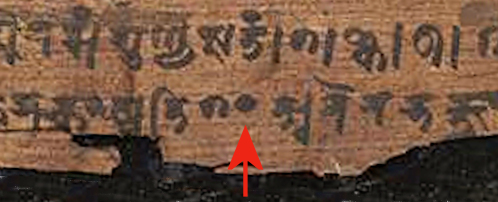
Positional notation is the idea that the same digit means different amounts depending on where it sits: the 3 in 30 is worth ten times the 3 in 3. To make that work you need a placeholder for an empty column — otherwise 306 and 36 collapse into the same string of marks. That placeholder is zero. The Babylonians had used a positional base-60 system with a gap for the empty place, and Indian astronomers used a dot, but it was Brahmagupta, writing in 628 AD, who first treated zero as a *number* — an object you can add, subtract, and multiply — and wrote down the rules for doing so.
Pourquoi cela a compté
Roman numerals can record a number but they cannot compute with it; to multiply MDCCLXVI by XXIV a Roman reached for an abacus or a table of counters, and the written figures were only a transcript of the answer. Place value moves the computation *into the writing itself*. Long multiplication, long division, carrying, borrowing — the paper algorithms every schoolchild learns — exist only because each column has a fixed value and zero holds the gaps. This is what let calculation escape the specialist and become a routine skill.
Comment cela a été fait
Brahmagupta laid out arithmetic in terms of "fortunes" (positive) and "debts" (negative), and defined zero as what remains when a number is subtracted from itself. Most of his rules are exactly right: a number plus zero is unchanged, a number times zero is zero. He also reached for the one operation that still breaks: division by zero, which he could not resolve — he suggested a number over zero simply stays a fraction with zero beneath it, a genuine dead end that would not be properly understood for another eleven centuries. The system spread west through al-Khwarizmi's arithmetic and reached Europe through Fibonacci's *Liber Abaci* (1202), where it slowly displaced the Roman numerals and the abacus.
Ce que cela a débloqué
Efficient calculation is the hidden prerequisite under almost everything quantitative that follows. Algebra needs it to manipulate unknowns without drowning in clumsy notation; double-entry bookkeeping and banking need it to reconcile ledgers; the decimal point, logarithm tables, and eventually mechanical and electronic computing all descend from the same move. Zero, treated as a real number, also opened the door to negative numbers and to the number line itself — the backbone of all later mathematics.
Version minimale viable
A base with a fixed set of digits, columns whose value grows by that base from right to left, and a dedicated zero symbol marking any column with nothing in it — so that 205 cannot be mistaken for 25.
Requiert
A débloqué
Fils passant par cette capacité
Why couldn't the Romans build a computer?7 étapesSources
- — Brahmagupta, *Brāhmasphuṭasiddhānta* (628 AD)
- — Georges Ifrah, *The Universal History of Numbers* (2000)
- — Charles Seife, *Zero: The Biography of a Dangerous Idea* (2000)
Quelque chose d'inexact sur cette page ? Chaque affirmation ici est censée survivre à la contestation. Suggérer une correction →