Zero and place value
A way of writing numbers in which a digit's meaning depends on its column, and a symbol for nothing — zero — holds an empty column open. Ten signs can then write any number, and calculation becomes a mechanical shuffle of digits instead of a scholar's art.
O arquivo profundo está escrito em inglês por enquanto — traduções verificadas estão nos planos. O recurso de tradução do seu navegador funciona bem nesta página.
✦ Espere, sério?
In 1299 the city of Florence banned the new Hindu-Arabic numerals from contracts and account books — not out of superstition, but fraud control: a 0 was too easily forged into a 6 and a 1 into a 7, whereas a spelled-out Roman "XII" could not be doctored. The numerals that now run all of world commerce were once outlawed as too easy to falsify.
O que é
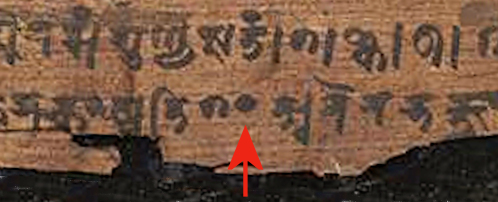
Positional notation is the idea that the same digit means different amounts depending on where it sits: the 3 in 30 is worth ten times the 3 in 3. To make that work you need a placeholder for an empty column — otherwise 306 and 36 collapse into the same string of marks. That placeholder is zero. The Babylonians had used a positional base-60 system with a gap for the empty place, and Indian astronomers used a dot, but it was Brahmagupta, writing in 628 AD, who first treated zero as a *number* — an object you can add, subtract, and multiply — and wrote down the rules for doing so.
Por que importou
Roman numerals can record a number but they cannot compute with it; to multiply MDCCLXVI by XXIV a Roman reached for an abacus or a table of counters, and the written figures were only a transcript of the answer. Place value moves the computation *into the writing itself*. Long multiplication, long division, carrying, borrowing — the paper algorithms every schoolchild learns — exist only because each column has a fixed value and zero holds the gaps. This is what let calculation escape the specialist and become a routine skill.
Como foi feito
Brahmagupta laid out arithmetic in terms of "fortunes" (positive) and "debts" (negative), and defined zero as what remains when a number is subtracted from itself. Most of his rules are exactly right: a number plus zero is unchanged, a number times zero is zero. He also reached for the one operation that still breaks: division by zero, which he could not resolve — he suggested a number over zero simply stays a fraction with zero beneath it, a genuine dead end that would not be properly understood for another eleven centuries. The system spread west through al-Khwarizmi's arithmetic and reached Europe through Fibonacci's *Liber Abaci* (1202), where it slowly displaced the Roman numerals and the abacus.
O que desbloqueou
Efficient calculation is the hidden prerequisite under almost everything quantitative that follows. Algebra needs it to manipulate unknowns without drowning in clumsy notation; double-entry bookkeeping and banking need it to reconcile ledgers; the decimal point, logarithm tables, and eventually mechanical and electronic computing all descend from the same move. Zero, treated as a real number, also opened the door to negative numbers and to the number line itself — the backbone of all later mathematics.
Versão mínima viável
A base with a fixed set of digits, columns whose value grows by that base from right to left, and a dedicated zero symbol marking any column with nothing in it — so that 205 cannot be mistaken for 25.
Fios que passam por esta capacidade
Why couldn't the Romans build a computer?7 passosFontes
- — Brahmagupta, *Brāhmasphuṭasiddhānta* (628 AD)
- — Georges Ifrah, *The Universal History of Numbers* (2000)
- — Charles Seife, *Zero: The Biography of a Dangerous Idea* (2000)
Algo errado nesta página? Cada afirmação aqui foi feita para sobreviver ao questionamento. Sugerir uma correção →