Fiber-reinforced composites
Two mediocre structural materials combined into an excellent one: hair-thin glass fibers, immensely strong in tension, embedded in a tough plastic resin that binds them, shares the load between them, and stops any crack from running. The result is light, strong, moldable, and immune to rust and rot.
深层档案目前以英文写就——经核验的翻译已列入路线图。浏览器自带的翻译功能在本页表现良好。
✦ 等等,真的吗?
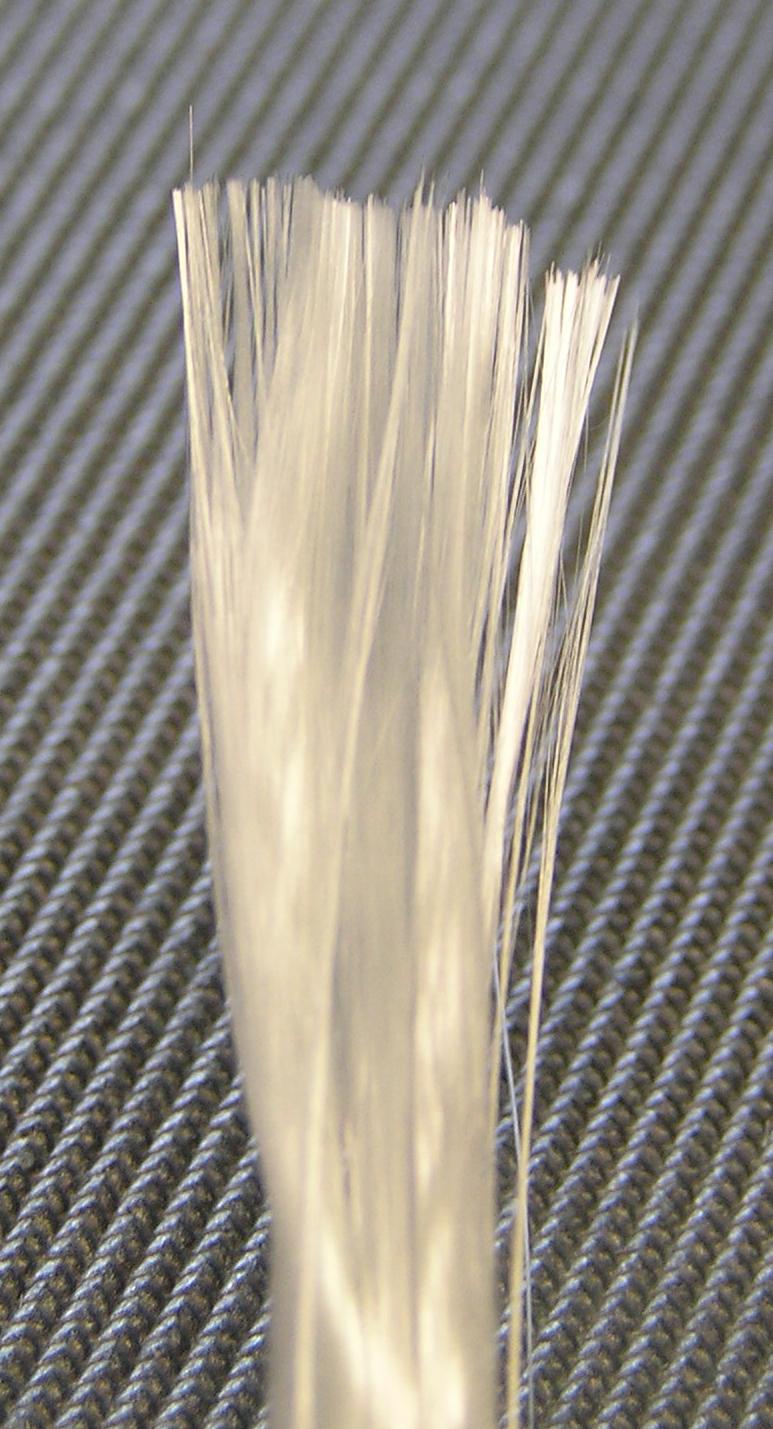
Glass drawn into a fine enough fiber becomes one of the strongest materials by weight — the same substance that shatters as a windowpane. A. A. Griffith showed why in 1920: ordinary glass fails at surface flaws, microscopic cracks that concentrate stress, and a hair-thin fiber is simply too slender to hold the big flaws. He measured glass fibers a few micrometres across at tensile strengths near half a million pounds per square inch — orders of magnitude above a sheet of the identical glass. Thinness alone converts the most notoriously brittle material into a high-strength fiber.
它是什么
A composite is a material made of two others that stay distinct but act together, each doing what the other cannot. In fiberglass the reinforcement is glass drawn into fibers thinner than a hair, which are extraordinarily strong when pulled along their length but, being glass, snap if bent sharply on their own. The matrix is a plastic resin — a thermoset like polyester or epoxy — which is tough and moldable but weak by itself. Embed the fibers in the cured resin and the resin holds each fiber straight, grips it along its length, passes load from one fiber to its neighbours, and blunts any crack before it can run through the whole part. The combination is far better than the sum: strong, stiff for its weight, and shapeable into anything a mould can hold.
它为何重要
Here was a structural material that was strong, light, electrically insulating, transparent to radio waves, and completely immune to the rust and rot that plague steel and wood — and it could be laid up by hand into complex curved shapes with no forging, casting, or machining, no press and no furnace. That combination did not previously exist. It gave designers a way to make large, strong, weatherproof shells cheaply, which is why fiberglass so quickly became the material of boat hulls, car bodies, tanks, and building panels.
它如何造出
The glass fiber came first, and partly by accident. Researchers at Owens-Illinois were chasing fine glass fibers when, in 1932, Dale Kleist tried to seal a joint between glass blocks with a spray gun built to throw molten metal; instead of a coating, the jet of compressed air tore the molten glass into a shower of fine filaments. Games Slayter developed the accident into a process for making glass wool in quantity, and Owens-Illinois registered the trademark "Fiberglas" in 1936; Owens-Corning was formed in 1938 to exploit it. The glass began as insulation and filtration, but paired with the new thermosetting resins of the late 1930s and 1940s it became glass-reinforced plastic, a structural material — famously used during the Second World War for aircraft radomes, where a strong shell transparent to radar was needed. The reason the thin fiber is so strong had already been explained by Griffith in 1920: strength is governed by surface flaws, and a fine fiber cannot contain a large one.
它解锁了什么
Fiberglass made moldable, corrosion-proof structures ordinary: pleasure-boat hulls, car and truck body panels, storage tanks, pipes, wind-turbine blades, printed circuit boards, and building cladding. More than any single product, it established the composite as a design principle — brittle fibers carrying load inside a tough matrix — and that principle carried straight on to the carbon-fiber composites now used in aircraft, spacecraft, and racing cars. It is the same bargain every time: take a material strong only as a thin thread, and lend it shape and toughness by casting it in plastic.
最简可行版本
A mat or weave of glass fibers laid into a mould and soaked with a liquid thermosetting resin that is then let cure hard — glass-reinforced plastic, taking the exact shape of the mould and needing no press.
重建配方
你需要
- · Glass fiber — as chopped-strand mat, woven cloth, or continuous roving
- · A liquid thermosetting resin with its hardener/catalyst (polyester resin is the classic; epoxy for higher performance)
- · A mould, waxed or release-coated so the finished part will let go
- · A roller or brush to work resin into the glass and press out trapped air
步骤
- 01Prepare the mould surface with release agent so the cured part separates cleanly.
- 02Lay glass fiber into the mould in the shape wanted, building up layers for thickness.
- 03Mix the resin with its hardener and wet out the glass thoroughly, so resin surrounds every fiber and no dry patches remain.
- 04Roll firmly to drive out air bubbles and press the layers together — voids are weak spots.
- 05Let the resin cure (it sets by chemical reaction, not drying); when hard, remove the part from the mould.
如何确认它成功了
A good laminate is stiff and rings when tapped, translucent and even in color with no white dry patches or trapped air bubbles, and the glass and resin act as one — flexed, it springs back rather than delaminating. Peeling layers apart, milky voids, or dull thuds on tapping mean poor wet-out or trapped air, and those parts fail early.
会出什么错
- ⚠ Dry glass (too little resin) — fibers with no matrix around them carry nothing and pull loose.
- ⚠ Resin-rich, glass-poor — a thick pad of pure cured resin is brittle and weak; the strength comes from the fibers, and there must be enough of them.
- ⚠ Trapped air voids — bubbles are stress raisers and paths for water, so the part cracks or delaminates from them.
- ⚠ Wrong catalyst ratio or a cold cure — resin that never fully hardens stays soft, sticky, and weak.
解锁
前沿——此后尚未绘制。
来源
- — A. A. Griffith, "The Phenomena of Rupture and Flow in Solids," *Philosophical Transactions of the Royal Society A*, vol. 221 (1921)
- — Games Slayter, U.S. Patent 2,133,235, "Method and apparatus for making glass wool" (filed 1933, granted 1938)
- — "The Fiberglass Story," *Invention & Technology* magazine (American Heritage)
发现本页有误?这里的每一条论断,都应当经得起质疑。 提交更正 →